Inclusive Educational Processes, Wellbeing, Equity and Social Protection
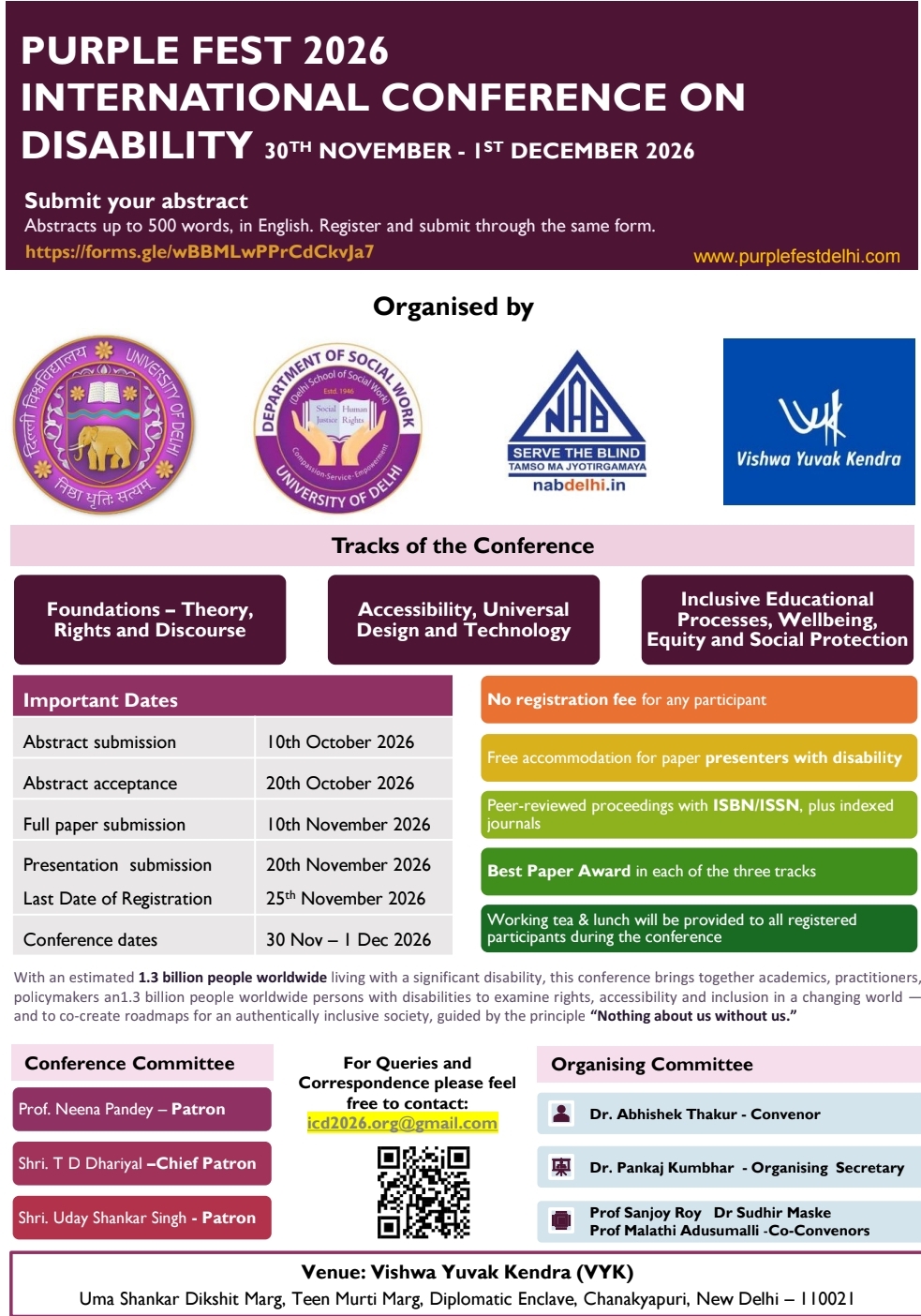
Disability is one of the defining human-rights and equity concerns of the twenty-first century. The World Health Organization estimates that about 1.3 billion people, roughly 16 percent of the world's population, live with a significant disability. Persons with disabilities are not a single, uniform minority. They are a cross-section of humanity, present in every community and across all ages, genders, geographical regions, and social groups. They include people with visible and invisible, congenital, acquired, and age-related conditions. The way disability is understood has changed markedly over the past two decades. The earlier language of welfare and charity has given way to social and rights-based models, and more recently to an approach centred on well-being and 'working together', guided by the principle of 'Nothing about us without us'. The United Nations Convention on the Rights of Persons with Disabilities (CRPD, 2006), now almost universally ratified, established disability as a question of rights, dignity, participation and inclusion. The 2030 Agenda for Sustainable Development, with its pledge to 'Leave no one behind', placed disability inclusion at the centre of global development. In India, the Accessible India Campaign (Sugamya Bharat Abhiyan launched in 2015) and the Rights of Persons with Disabilities Act (RPWD), 2016 have widened the legal and programmatic basis for inclusion. Even so, the gap between policy commitments and everyday experience, with reference to services, decent work, education, health and public life of the persons with disability remains a central challenge in the present context. In a world reshaped by rapid technological changes, digital and e-governance, urbanisation, migration and shifting legislation, accessibility can no longer be read narrowly as barrier-free infrastructure. It now encompasses public services, information and communication, education, financial systems as also emerging technologies (assistive technology and artificial intelligence), so that people are not excluded by the way systems are designed. Inclusion also depends on livelihoods: decent work, inclusive workplaces, entrepreneurship and support for disability-led enterprises. It calls for early intervention across the life course, equity, and social protection that reaches those most at risk of exclusion. This International Conference aims to deepen scholarly and practitioner discussions on enterprise, accessibility and inclusion, and to examine the emerging issues, challenges and possible ways forward for the persons with disability. Open to all categories of disability, it brings together a range of stakeholders to build together an authentically inclusive society.
Digital+Print